

Moments That Matter: Root Applied Sciences Helps More and More Farmers ‘See’ Invisible Threats
June 24, 2026
Celebrating the turning points that define our current and alumni fellows’ journeys.
Without being able to detect airborne threats—from mold spores, to bugs, to other plant pathogens—farmers are subject to a guessing game when it comes to treating their crops for diseases and pests. With their yields on the line, they’re forced to spray prophylactically, which is expensive, labor-intensive, and has environmental consequences.

Root Applied Sciences (Sarah Placella, Cohort 2022) fundamentally changed this by giving farmers the first-ever monitoring system that was robust enough to depend on to make these high-stakes decisions. Based on a proprietary assay designed by Placella and a sensing device that samples a large volume of air, Root’s monitoring system is highly sensitive, precise, and able to identify threats while they’re still in the air—giving growers at least a week to respond and protect their crops.
Placella founded Root in 2018 and was an Activate Fellow in Cohort 2022. Since then, the pressure on growers—and the need for Root—has only increased.
Root began in wine grapes, where grapevine powdery mildew has devastated vineyards year after year and fungicide overuse is widespread. “At present, the wine grape industry is in one of its largest recessions we've ever seen here in the U.S.,” said Dion Harste, Root’s Chief Commercialization Officer. “At this point, if you have sellable fruit, it's like gold.”
Fortunately, Root makes a proven impact when it comes to relieving the strain on farmers, especially in what they call “high-pressure” years—when challenges related to weather, pathogens, pests, and or costs compound. Early data showed that Root customers were able to cut their fungicide application by 20-80%. One farmer saved $34K in one season by lengthening the intervals between sprays, and many others drastically shifted their pesticide management strategy thanks to real-time data from Root sensors.
Early data showed that Root customers were able to cut their fungicide application by 20-80%. One farmer saved $34K in one season.
These farm-level improvements add up to greater impact. Placella estimates that at scale, Root could prevent several gigatons of carbon dioxide equivalents by 2050 by reducing crop loss and cutting chemical pest management applications.
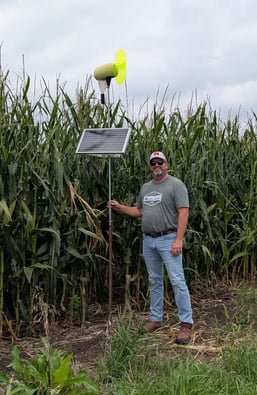 Now, Root has entered the Midwest to help farmers defend their corn fields against ever-evolving threats. Following successful pilots in Nebraska last year, Root is expanding to Minnesota through new partnerships with the Minnesota Corn Growers Association and the Minnesota Corn Research & Promotion Council. Root’s work in Nebraska is also expanding with collaborators at the University of Nebraska-Lincoln supported by a grant from the Nebraska Corn Growers’ Association.
With a network of over 70 monitoring stations in Minnesota, Nebraska, and Iowa, Root is poised to track two aggressive fungal diseases in corn—southern rust and tar spot—and answer key questions about how Root’s network can improve their management.
We chatted with Placella and Harste about Root’s journey so far—from Placella’s burning need to start Root to now having earned the trust of growers—and the vast opportunities ahead for the innovative pathogen monitoring company.
Where were you professionally and personally when you decided to become a founder?
Sarah Placella: I had successfully switched from academia to industry. I'd worked at a couple startups, and I'd become the product manager at one. So I had already professionally made that transition toward a business mindset. Personally, I was the mom of two young kids.
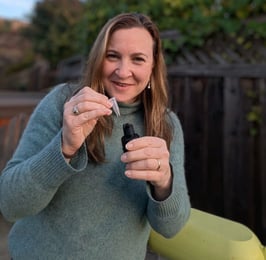
In my previous role, I had been talking to a lot of growers who were struggling to get information that I knew how to get based on my academic background, but that we as the academic community had failed to make available to growers, which is really difficult.
I saw that as an opportunity where I could make a real impact. I wasn't one of those founders who was like, “I want to be a founder.” I was really more like, “There's a real problem and opportunity here, and I am one of few people who can really help.”
I had seen a couple other female founders run companies, so that also gave me the confidence to think that maybe I could do it, too.
I had seen a couple other female founders run companies, so that also gave me the confidence to think that maybe I could do it, too.
How did Root set out to solve problems for growers?
SP: Before I started Root, there was nothing like it available, and growers had no way of knowing what was in the air. There was one small outfit that was providing a pathogen monitoring service for wine grapes, but the growers I interviewed said it wasn't sensitive or fast enough to really be useful.
Before I started Root, there was nothing like it available, and growers had no way of knowing what was in the air.
I'm very much a product-minded person. So it came down to not “What is the coolest technology that we can build?” but “What can we build that will solve this problem?”
We developed our own capture system that is much better than anything else available—still. We tied it to a proprietary assay that I developed in-house, that is designed to be very sensitive and also very fast and ultimately something that can be scaled easily. It's also robust under a variety of conditions, and it's streamlined so that one day we hope that it will be fully autonomous.
What makes Root different from other options for farmers?
Dion Harste: I work with growers that have been clients of mine for many, many years. They look at Root as number one. It’s scientifically much more sound in the way that it collects the data, utilizing more of an active air exchange system than a passive one, and pulling air through a device at about four to five times the volume of the nearest product to us. Then about twice a week, we collect that data and take it to a full PCR lab.
All of that lends to more credibility, and when you're introducing an innovative product, it’s all about trust. And so you gain trust very quickly when you're consistent.
…when you're introducing an innovative product, it’s all about trust. And so you gain trust very quickly when you're consistent.
In addition, our ability to be very versatile and go across multiple crops sets us apart. I'm here in the Midwest right now, and we're in planting season. We’re already going to be able to test the pathogens that have arisen very recently here.
Why is customer trust so important to you?
SP: Given what we're working on—which is helping farmers better manage their airborne threats like fungal pathogens—if we're wrong, then they can't trust us, and they can't use the technology.
So it's really important that we really do have the best, most sensitive technology. And it's only after we have years of data that we could potentially dial it back and say, you know what, maybe we don't need to sample as frequently to deliver results with the same level of confidence.
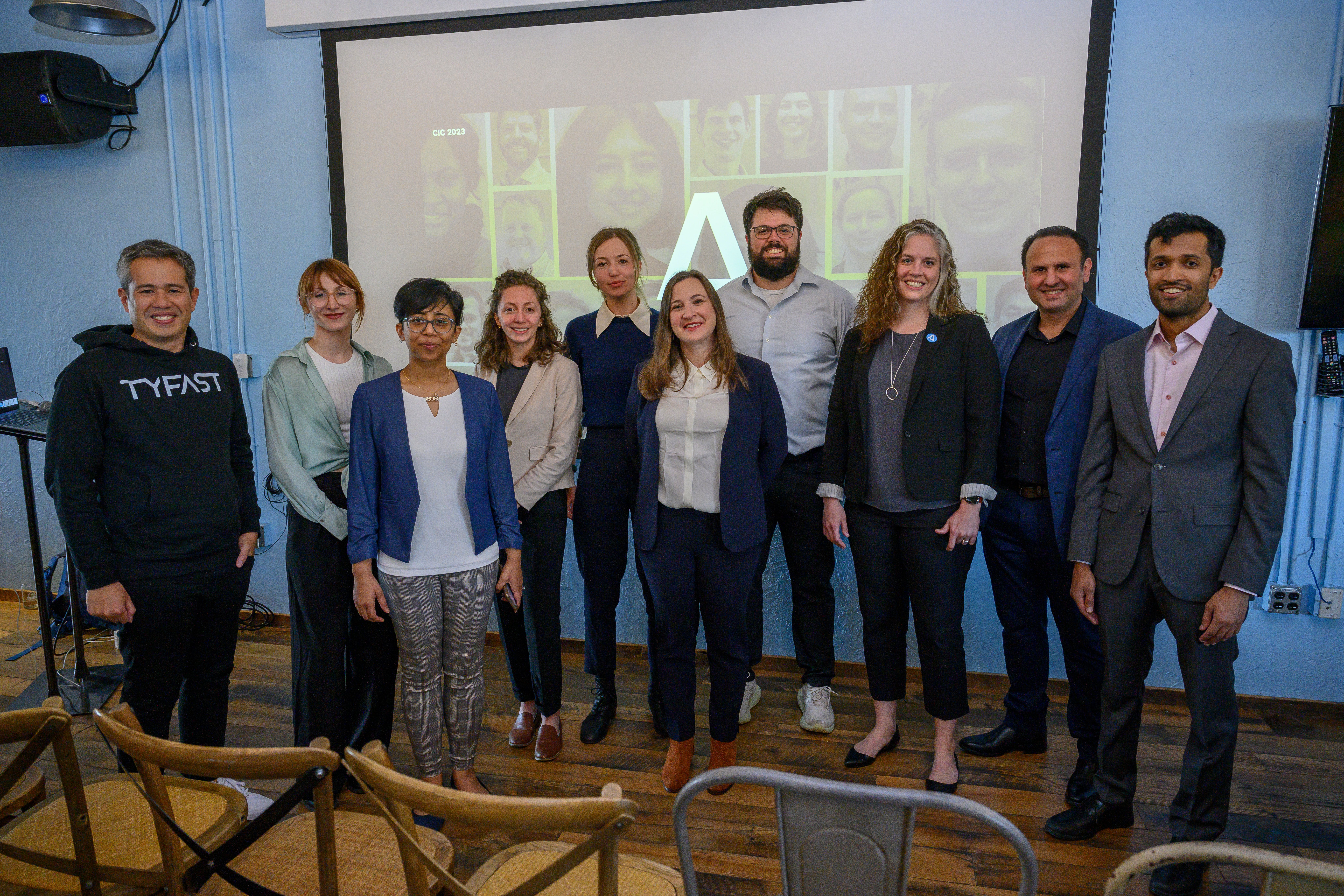 Sarah Placella (center) and other Activate Fellows presented at Activate Demo Day in 2023.
What will the world look like if Root is wildly successful?
SP: We're digitizing the air. So ultimately, we'll have a world full of sentry stations that are monitoring what's around us.
Ultimately, we'll have a world full of sentry stations that are monitoring what's around us.
This allows people to be able to spray fungicides and pesticides at just the right time, for just the right thing. But it's more than that. Our breakthrough technology can reliably amplify DNA from dirty and inconsistent samples—so it is widely applicable outside of agriculture as well.
What future applications could precision pathogen monitoring technology have?
SP: It could really help us from a public health standpoint as well. We're having measles outbreaks right now. If we had consistent, reliable information on where measles had been detected, we could really track it and make more educated decisions about how to avoid it.
So I think that agriculture is a place where we can demonstrate clear value and have a lot of impact. It's win-win-win—a win for the farmer, for the farm workers, and for the local communities that often bear the brunt of fungicides.
But outside of that, there are so many additional ways to use the technology—I don’t think I can even imagine all of them now.
What advice would you give someone who’s thinking about going from scientist to founder?
SP: Follow your heart and enjoy the journey.
For me, it was like, “I have to do this.” Founding Root was a burning thing that I needed to do.
Founding Root was a burning thing that I needed to do.
So if that's how you feel, then you should just do it. And if that's not how you feel, you probably shouldn't be a startup founder—or not for this opportunity.
I feel like some people want to be founders, but it's not about being a founder—it's about founding this thing. If you don't feel that way about this thing, then it's not the thing.
