

Activate Welcomes 50 New Fellows to Cohort 2026
July 14, 2026
Meet the 41 Hard-Tech Companies Across 5 Activate Communities
The challenges defining our era—how we make energy, grow food, build materials, treat disease—won't be solved by incremental improvements. They'll be solved by scientists and engineers willing to bet their careers on a better answer.
Today, we are announcing the 50 scientist-innovators of Cohort 2026. The 41 companies they're building span 22 cities and 11 states across the United States, joining Activate's communities in Berkeley, Boston, Houston, and New York, as well as Activate Anywhere.
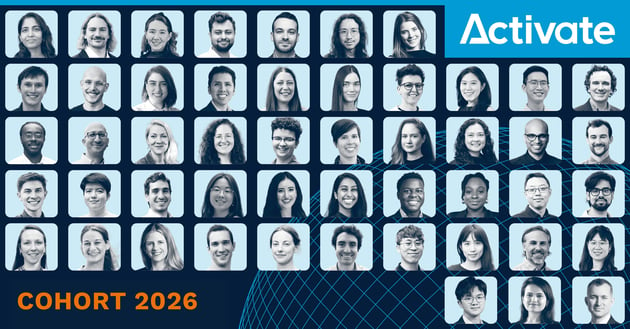
“This cohort clearly demonstrates that the next industry-defining companies won't choose between modern technology and deep science; they'll be built by combining both,” said Cyrus Wadia, CEO of Activate. “These are the scientists and engineers turning our most urgent global challenges into the companies that will deliver a more sustainable future.”
Activate Anywhere
Hard-tech innovation happens everywhere—and so does Cohort 2026. The Activate Anywhere Community brings together scientists and engineers building across the country, connected by Activate's network of mentorship, education, and community regardless of geography. With quarterly in-person gatherings, Anywhere fellows get the full fellowship experience without leaving their local ecosystem.
This year's Anywhere fellows are working across industrial decarbonization, antimicrobial resistance, food systems, and advanced materials—tackling problems that don't fit neatly into any one geography or sector.


- Laura White, Andon Bio
- Anthony Berardi, Citrimer
- Anmol L. Purohit, CureXco
- Solene Moulin, Haven Biofoundry
- Spencer Dansereau, Mach Electric Inc.
- Devon McCornack, Marva Labs
- Stacy Anderson & Lindsey Williams, Primary Bioscience
- Amy Jean Swanson, Ultropia
Activate Berkeley
Activate's longest-standing community, Activate Berkeley, marks its 12th cohort partnering with the Cyclotron Road program at Lawrence Berkeley National Laboratory. Berkeley fellows may gain access to the Lab's expertise and world-class facilities, including the Molecular Foundry and Advanced Bioprocessing and Development Unit. All fellows join a decade-deep alumni network built through hard-tech commercialization.
This year's Berkeley fellows are pushing the boundaries of food systems, energy infrastructure, and advanced materials, working in one of the country's most established ecosystems for translating science into impact.


- Matthew Szarzanowicz, BasidioBio
- Nicolas Herard, Euler Materials
- Saurabh Malani, Fermeate
- Bo Xu, Gilly
- Yashee Mathur, Hydrify
- Charles Dove, NeoOptics
- Elizabeth Hann & Marcus Harland-Dunaway, Nolux
- Lucy Wu & Edson Perez, PeraWatt
- Zach Detweiler, Radify Metals
- Jinyu Guo & Kindle Williams, Recovered Potential
Activate Boston
The Activate Boston Community is based in Kendall Square, Cambridge—one of the world's densest concentrations of research institutions, startups, and investors. With formal partnerships at The Engine, memberships at CIC, and deep connections to MIT and Harvard, Boston fellows are building in one of the most resource-rich environments in hard tech.
This year's Boston fellows are working across energy, food systems, coastal resilience, and advanced manufacturing—reflecting the breadth of Boston's innovation ecosystem and its tradition of supporting high-impact science across fields.


.png?width=1200&length=1200&name=Walt%20Zesk%20(1).png)


.png?width=1200&length=1200&name=Manichandra%20Morampudi%20(2).png)


- Camron Blackburn & Alex Wynn, Adiabatic Machines
- Miana Smith, Apidae Forms
- Walter Zesk, Coastal Assembly
- Natalie Rubio & John Yuen Jr., Deco Labs
- Michael Saad & Sophie Letcher, EntoCellular
- Katya Boukin, Flood Dynamics
- Mani Chandra, nOhm Devices
- Ruofan Wang & Joshua Persky, Teragen Energy
Activate Houston
Home to the largest concentration of engineers in the United States and a dense ecosystem of Fortune 100 and Fortune 500 companies, Houston is uniquely positioned for scientists tackling large-scale industrial challenges. Activate Houston fellows are connected to the city's deep networks in energy, chemicals, and materials.
This year's Houston fellows are working across energy, space, AI infrastructure, and agriculture—bringing a new generation of science-driven companies into one of the country's most powerful industrial ecosystems.

.png?width=1200&length=1200&name=Katherine%20Andersen%20(1).png)


- Sophie Clare Broun, Anning Corporation
- Kathy Andersen, Brint Tech
- Dorsa Talebi, Kinetiq Drive
- Neethu Pottackal, Nivera
- Jonathan Huffman, Orbital Arc
- Tim Lee, Renesin
- Joshua Livingston, Selerra Separations
- Wenli Jiang, SwieNitro Recovery
Activate New York
Located in the heart of New York City, the Activate New York Community gives fellows access to office space in Manhattan and a dense network of investors, startups, and partners. It's a community built for scientists ready to build companies at the center of one of the world's great innovation ecosystems.
This year's New York fellows are working across life sciences, advanced materials, space, defense, and agriculture—spanning scales from the nanoscale to low-Earth orbit.


- Ella Csuka, Ecotune
- Grace Akinyele, Mitovon Biosciences
- Elsy El Khoury & Naixin Qian, Nanovib
- Xingyu Du, OneFiltr
- Tongwei Xu, Redox Metals
- Stefan Bell, Sagitta Borealis Systems
- Akhila Mallavarapu, Vividence Labs
This marks the 12th cohort for Activate, which was founded in 2015. Over the past decade, Activate Fellows have created more than 275 companies. These companies have raised over $5.5B in follow-on funding and created over 3,000 new jobs across the United States. This year's fellows were selected from over 850 applications.
.png?width=622&height=805&name=Activate-Cohort-2026-Infographic-v3%20(1).png)
As a nonprofit organization, Activate relies on partnerships with funders across government and private philanthropy to make the fellowship possible. Supporters of Cohort 2026 include the U.S. National Science Foundation (NSF), Mass Clean Energy Center (MassCEC), the National Institute of Standards and Technology (NIST), an agency of the U.S. Department of Commerce, and Cyclotron Road, a U.S. Department of Energy Lab-Embedded Entrepreneurship Program (LEEP) at the Lawrence Berkeley National Laboratory.
Activate is a 501(c)(3) nonprofit dedicated to turning scientific discoveries into real-world impact. Through partnerships with government, philanthropy, universities, and industry, Activate builds the cross-sector ecosystem that drives hard tech innovation—equipping scientists and engineers with world-class resources, training, and community to bring their work from discovery to deployment.
