

Moments that Matter: Cella’s ‘Big Swing’ Is Paying Off
June 4, 2026
Celebrating the turning points that define our current and alumni fellows’ journeys.
Since becoming a founder, Claire Nelson (Cohort 2023) has defied norms. Her company, Cella, skipped the lab scale entirely, going straight from modeling to field demonstration. They took a big swing early, raising a seed round to drill a pilot well in Kenya that’s deeper than the world’s tallest skyscraper is high. And now, after a historic field test, their bold path is paying off.
 Nelson is the co-founder and CTO of Cella, a first-of-its-kind carbon storage company turning CO2 into rock for safe and permanent removal. Cella aims to unlock the carbon storage needed to match the growing demand for carbon capture.
Nelson’s journey began during her postdoc at Columbia University, where she researched ways to inject CO2 underground at scale. She wondered why more companies weren’t using mineralization to store carbon. When she realized it was because of an expertise gap, she decided “Why not me?”
She and Cella co-founder Corey Pattison had identified the same bottleneck: the existing method of injecting CO2 into basalt required enormous amounts of water, limiting widespread adoption. They had a hunch they could solve this problem and finally unlock carbon storage through mineralization at scale.
Nelson envisions Cella becoming part of a “patchwork” of carbon management solutions. Cella’s core value proposition is geographic expansion—unlocking carbon storage in regions that have suitable rocks but lack conventional sedimentary reservoirs. Cella decarbonizes "stranded emissions" from industrial facilities too far from traditional storage sites to be economically served, filling in critical gaps on the global map.
When Nelson applied to Activate, Cella had been incorporated for about a year, but both co-founders still held full-time jobs. During Cella’s first birthday party, she got word of her acceptance into the Activate New York Community.
Recently, on Cella's fourth birthday, the company achieved a historic milestone: at its pilot well in Kenya, the team completed its first injection of pure-phase CO2 underground into basalt rock—becoming the first company to ever do so. “It’s what we've been working towards for the past four years,” Nelson said. Noting strong early results from the successful pilot, she said, “It’s a big step forward for the entire field of subsurface carbon mineralization.”
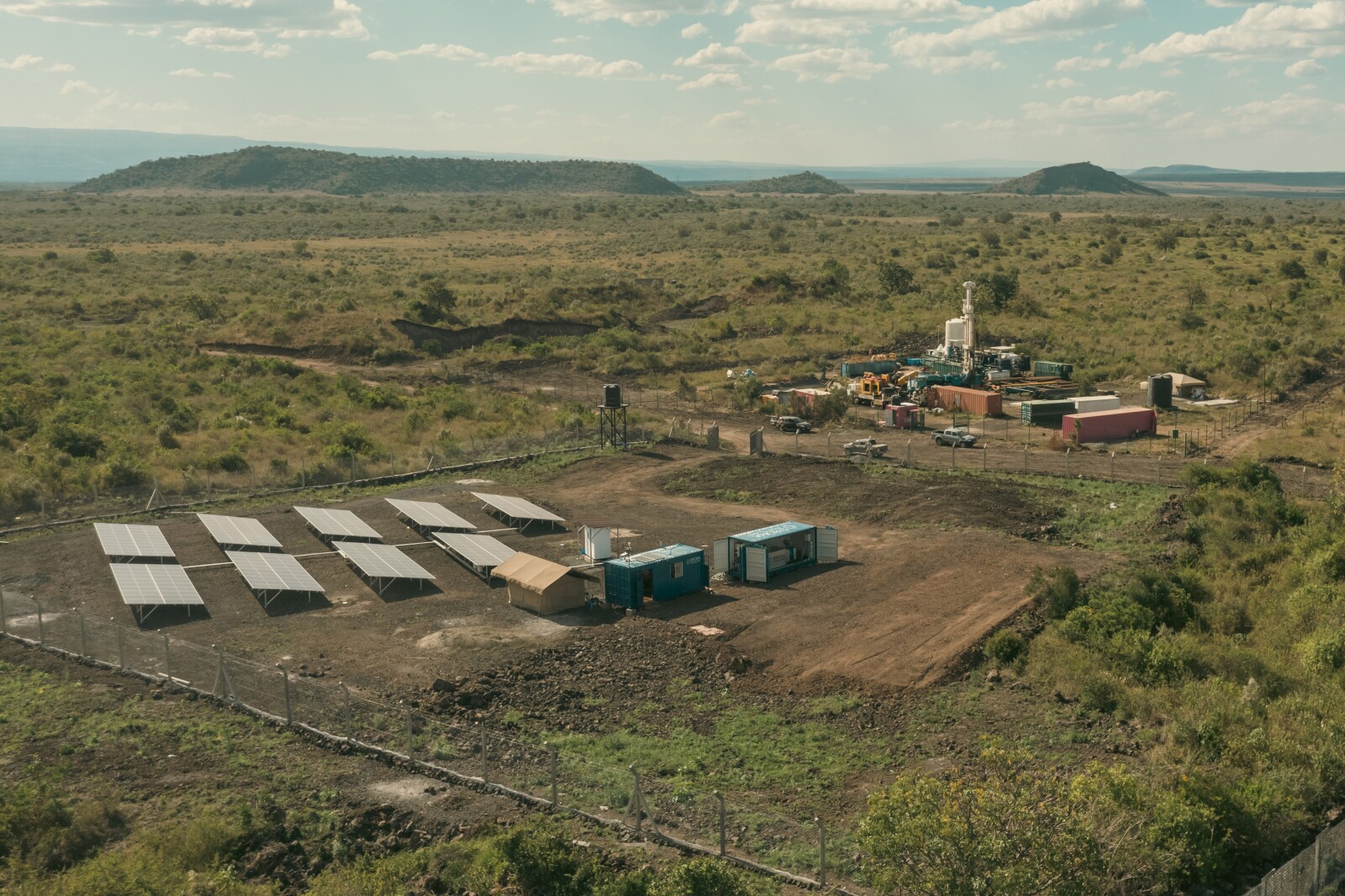 Source: Cella
We chatted with Nelson to reflect on the path that led Cella to this big moment.
Tell us more about the unexpected “big swing” you took early on.
Our founding story was like this: we know enough science, we need to just get out in the field and demonstrate this is possible.
That made us atypical in terms of an Activate company. We skipped lab scale altogether and went straight from modeling to the field. We took a really big swing and spent pretty much our entire seed funding on drilling a well 800 meters underground, which is deeper than the tallest building in the world is high. A literal money pit.
Everyone was kind of like, “My god, what are you doing? Why are you spending equity dollars on this expensive CapEx thing?” Friends of Cella were really supportive of the big swing, but I also felt like we were all holding our breath for a few years wondering if this was going to work—and then it did.
How does Cella “borrow” techniques from the oil and gas industry?
Geologic carbon storage is actually something that’s been somewhat “accidentally” practiced in the field for over 50 years for the purposes of enhanced oil recovery. Basically, energy companies have been injecting CO2 underground to try to push more oil out from other wells in a specific reservoir.
Kind of like Fervo—how they're like, “We know how to frack; let's just apply that to enhanced geothermal.” Similarly, we know about injecting CO2 underground for enhanced oil recovery, and we’re saying, “Let’s apply those same techniques for mineral carbon storage.”
Our goal as a company is to take all of the know-how, infrastructure, and operational expertise that's been demonstrated and proven at this massive scale and apply it to new types of rocks (that have only been experimented on at small scales) and for a new purpose.
How have industry incumbents reacted to Cella?
One of my goals for this project was to demonstrate to the world of geologic carbon storage, which includes this giant oil and gas world, “Hey, this new thing is possible with the tools that you already use. It’s actually not that far of a leap and you can apply your existing business streams and value chains to this new market for this new purpose.”
We've gotten a lot of really amazing feedback and validation from big players in the energy industry, even though this was such a small experiment. There was a little part of me that I was afraid that they would laugh me out of the room and be like, "That's a nothing-scale. Come talk to us when it's 450,000 tons of CO2.” But that hasn't been the case.
People who do this every day at giant scales are impressed. And that audience sets the highest bar for us, because those are the people, frankly, who we need to help us bring this technology into the world on a scale that's relevant for climate.
How has your team evolved since founding and where are you now?
It was just Corey and me for a long time. We didn't hire our first person until maybe 18 months after we incorporated, around September 2023.
Now we have 10 people spread around the world—in Houston, New York, and Kenya—and we’re about to hire our 11th. So far we've raised $4.8M in venture funding and another $3M in revenue. And are about to start raising our series A.
 Claire Nelson at the 2023 Activate Reunion in Tiburon, California.
The number one topic for all my Activate mentoring had to do with management of people because I literally never had a real job before. Even in academia, I didn't have a lab group. I was just kind of on my own.
So that was a big challenge for me, especially as the team grew across different locations and workflows.
This is one of the reasons I say we would have failed forever ago without Activate.
How else did Activate impact you?
The mentorship blew my expectations out of the water.
 Andrew [Chang] was the Activate New York Managing Director at the time. It was just like having an experienced, super knowledgeable, patient, and empathetic cheerleader who's unconditionally supportive. Having someone who's like a guide and a champion, but never judges you and never tells you what to do—I had never had that in a mentor before.
Beyond Andrew, the community mentors are incredible as well.
With everybody posting on LinkedIn about Fervo's IPO and all the pictures of them ringing the bell, I’m reminded that Tim [Latimer] takes my call and answers my Slack message every single time.
The people from Zanskar—Carl [Hoiland] and Joel [Edwards]—who are also super busy and successful are incredibly valuable and generous alumni mentors for me.
And I think something like that could only happen at Activate. You wouldn’t find that same sense of community at any other accelerator.
What’s next for Cella?
.jpg?width=1600&height=1067&name=MWI%20175%20(1).jpg) Claire Nelson talking to Cyrus Wadia, CEO of Activate, at the 2024 Activate Reunion in Boston.
Claire Nelson talking to Cyrus Wadia, CEO of Activate, at the 2024 Activate Reunion in Boston.
We’re currently looking for a couple different types of partners.
We’ve been getting a lot of inbounds from customers that are like, “Hey, I'm an emitter here. I vaguely know that I'm near basalt. Can you help me?”
The second type is execution partners—people that drill wells, build compressors, are engineering companies that can actually build all the plumbing that it's going to take to get their CO2 from the smoke stack to the wellhead. Those also include point-source capture technology companies that build the scrubbing towers and the chemistry to actually just remove the CO2 from the smoke stack.
We also just started kicking off our series A and ideally our investors will be strategic partners that sit somewhere in that value chain.
Even right now in this current lull in the carbon-tech hype cycle, people are still excited to partner with Cella because they see us as a way to basically open up opportunities for them to do their existing business in new geographies and markets.
