

Hard Tech To Market: Lightfinder Is Bringing the Lab to the Field at the Speed of Light
August 24, 2026
Stories of Activate Fellows and alumni turning scientific breakthroughs into hard-tech impact.
In May, Diana Mojahed (Lightfinder, Cohort 2025) pitched her innovation to a multi-trillion-dollar market cap audience at the 2026 Lam Capital Venture Competition—and won. Now, with crucial new exposure, validation, and funding, she is ready to “hire, accelerate, and move faster.”
 Lightfinder is built on a breakthrough from the MIT lab where Mojahed did her postdoctoral training: a laboratory-grade spectrometer that fits on a silicon chip. The next-generation photonics company is developing precision optical sensing, paired with AI, that could provide a new class of real-time insights across several industries.
“Diana and the Lightfinder team are shrinking a $100K+ lab instrument down to a chip,” said Josh Martin, managing director of the Activate Boston community.
Currently, these instruments—spectrometers—are big, expensive, specialized boxes that live in labs, Martin explained. Lightfinder miniaturizes them, building them on silicon in the same foundries that are already making computer chips.
“This is an unlock because it means the cost curve looks like a semiconductor's, not like a scientific instrument's,” said Martin.
The innovation also brings spectrometry, a powerful light-measuring technology for imaging, sensing, and diagnostics, to far more settings.
“We live in a world where data is a hot commodity, and spectrometry on a chip means that these sensors have the ability to start showing up everywhere: bolted onto industrial equipment, embedded in other system sensors, and deployed in the field,” said Martin. “That's the same type of shift that turned GPS and cameras from bulky, expensive, hard-to-access equipment into ubiquitous technology.”
Mojahed, a biomedical engineer, initially developed the innovation with pathology in mind—then it became clear that it could revolutionize operations in a variety of industries: data communications, energy, semiconductor manufacturing, medicine, and beyond.
Today, that vision is turning into hardware as Lightfinder demos its prototypes with customers. "It's really exciting when you work on something for a very long time—you start to get impatient for it to happen," Mojahed said.
Now, Mojahed is entering her second year as an Activate Fellow with a clear goal: “growing the business from early wins to aggressively building the product and getting it into customers' hands.”
Specifically, Lightfinder plans to leverage $1.85M in new funding—a $600K SAFE round anchored by the Lam Capital prize, plus a $1.25M NSF SBIR Phase II grant—to grow the team, deepen customer engagements, and build its next generation of prototypes.
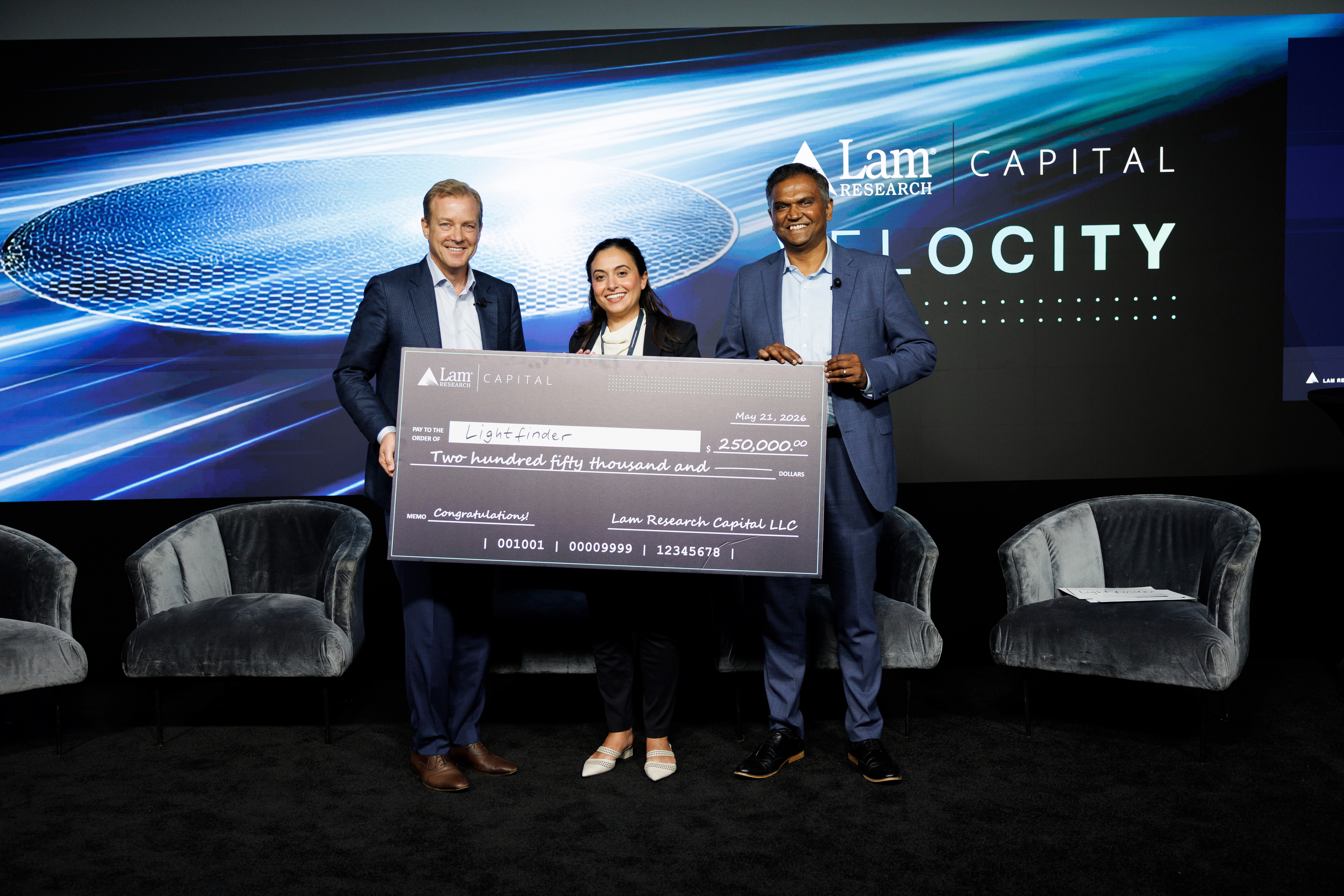 Photo: Diana Mojahed / Lam Research
As Lightfinder gains momentum, we spoke with Mojahed about her path from researcher to CEO and her vision for a future where finding light will unlock a new world of possibilities.
What will Lightfinder’s impact look like when it reaches its full potential?
I like to think of the impact as the equivalent to that of wearables—but for industry. Wearables put a sensor on everyone's wrist; what industry needs is instrument performance with that kind of ubiquity. Customers in data communications, energy, semiconductor equipment, and pathology could take real-time, high-fidelity measurements at the point of operation, instead of waiting on a result from somewhere else.
There are plenty of cheap sensors out there, but they aren’t very useful. You can't make a high-impact decision with a low-performance sensor—you'd rather wait for the lab result.
If that changes, you could have thousands of sensors embedded in your operations, and analyze trends across miles of fields, several factories, and multiple pieces of equipment. The first-order impact is smoother operations, lower cost, and fewer errors. The bigger one is that we could enable an entirely new class of insights—the way wearables did.
You could have thousands of sensors embedded in your operations, and analyze trends across miles of fields, several factories, and multiple pieces of equipment… we could enable an entirely new class of insights—the way wearables did.
How did you know Lightfinder couldn’t just exist in the lab anymore and needed to become a company?
During my Ph.D. at Columbia, I was encouraged to take a class called Lab to Market, which was about translating innovations out of the lab. I always thought I was going to be a professor, so I thought the class would be interesting, but I didn’t think I was going to be a CEO. I thought the biggest impact I could make in my career would be to continue doing research as a scientist.
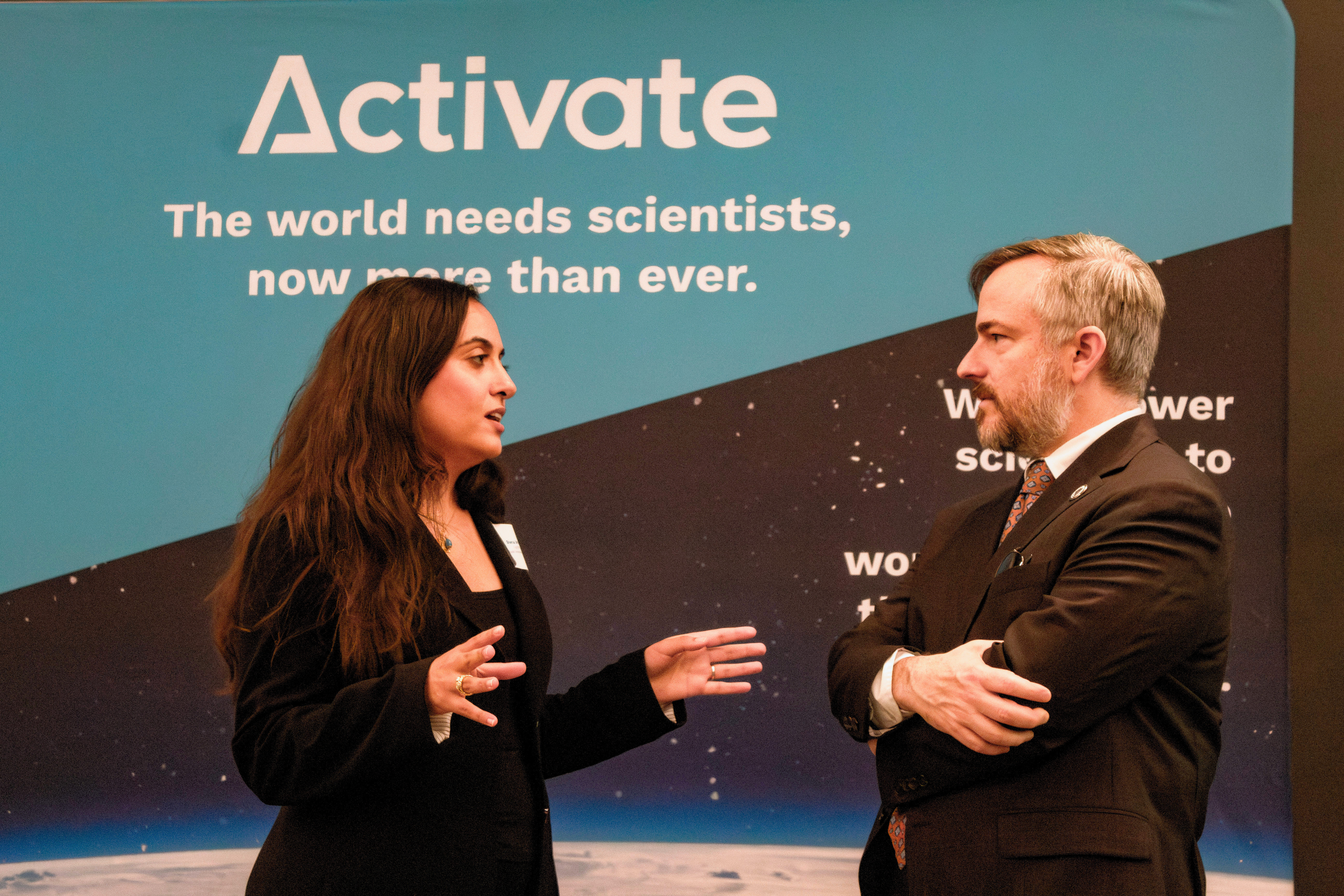 Mojahed (left) at the Meet Cohort 2025 Activate Boston event.
But the class made me realize my work had already moved past the early-stage research where most academic projects live. By being so focused on solving a real-world problem during my Ph.D., we actually had a business on our hands: a huge problem—people making decisions in the field while the measurements they needed sat in a lab—and a real solution with competitive advantage. If we really wanted to have an impact, the next step was starting a company.
But I felt there was more to do to really hit it out of the ballpark. I knew we were missing some things if we wanted the technology to not just win in a year or two, but to be the best technology in ten years. Because if you want to spin out a deep-tech company, you're not building for the world of today, you’re building for the world ten years from today.
If you want to spin out a deep-tech company, you're not building for the world of today. You’re building for the world ten years from today.
So I decided to do a postdoc—specifically in a lab that was working on exactly what I knew the technology needed to win in the market. Beyond the groundbreaking research, MIT has so many offices and support programs for entrepreneurs. I was specifically put on a grant that had a component of doing NSF I-Corps, and I got a prestigious fellowship called the Kavanaugh Fellowship, which let me set aside more of my time to work on starting a company.
Then, in developing a solution to solve a hard problem in pathology, we realized we could solve a lot more problems, and that’s how we ended up with one core technology that solves problems in many markets.
Based on these experiences, what would you tell a scientist who hasn’t taken a “lab to market” class or considered entrepreneurship yet?
To scientists and engineers, I would argue that commercialization is a requisite part of real-world impact—whether you want to do that yourself or you just want to understand how to do better research to solve real problems.
I think everyone can benefit from entrepreneurial education, whether you want to start a business or not, because the way you learn how to problem-solve in a business context is also really helpful as a scientist. There are so many skills to learn that your traditional scientific training doesn't cover.
How has the transition from technologist to CEO been for you?
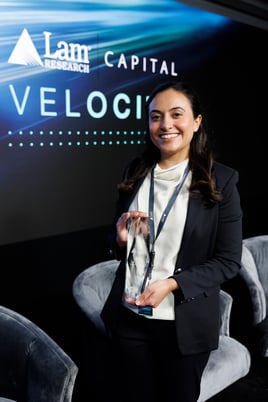 I am so glad I made this decision, because I am really enjoying everything about running a business. I've always been very extroverted—I really like talking to people and thinking about the bigger picture. Now, as CEO, I get to do all of that and I love it.
As CEO, I’m currently focused on three areas that I think will most determine Lightfinder’s success: the product, the customer, and the team.
Being a technologist naturally helps me approach product definition. It has also earned me a lot more credibility with customers, who themselves are usually technical. Our sale is a deeply technical sale.
Your parents started their own business. What did they think of you starting yours?
My parents always wanted me to succeed in whatever way made me happy. I grew up in their dry cleaning business, so I definitely had the personal traits needed to build something from scratch. Starting my own business has made me respect what they did a lot more. They managed the business and our family so gracefully my whole life, and I hope to do the same.
Do you think you would be able to go this fast if you weren't an Activate Fellow?
There are so many decisions I've had to think through in the past year that I don't know what I would have done without Activate, to be honest.
My managing director has been amazing. My cohort has been great, as well as the friends I’ve made within the rest of the Activate community. I've just learned so many things I wouldn’t have learned otherwise by being around inspiring entrepreneurs and in Activate programming.
Activate is unique in the sense that it doesn’t teach just one model for doing business across different technologies and companies. It teaches you what your options are. I think when you understand all your options, you make better decisions. Activate gives founders the tools and the time to be able to make good decisions.
Ultimately, I believe that an educated founder is better for the company, the investors, and the customers.
I believe that an educated founder is better for the company, the investors, and the customers.
What’s next for Lightfinder? Who should reach out to you right now?
Customers looking for high-fidelity sensing in the field, who are currently operating in the dark because the measurement they need lives in a lab. We’re here to solve their problems.
Investors who want to be part of what we're building—we’ll be fundraising a much larger round soon!
And anyone who's excited by our mission and technology and would like to become a part of the team—we’re hiring.
