
Activate Welcomes 50 New Fellows to Cohort 2026
July 14, 2026
Meet the 41 Hard-Tech Companies Across 5 Activate Communities
The challenges defining our era—how we make energy, grow food, build materials, treat disease—won't be solved by incremental improvements. They'll be solved by scientists and engineers willing to bet their careers on a better answer.
Today, we are announcing the 50 scientist-innovators of Cohort 2026. The 41 companies they're building span 22 cities and 11 states across the United States, joining Activate's communities in Berkeley, Boston, Houston, and New York, as well as Activate Anywhere.
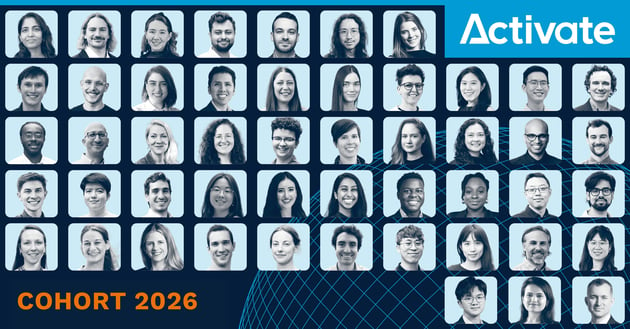
“This cohort clearly demonstrates that the next industry-defining companies won't choose between modern technology and deep science; they'll be built by combining both,” said Cyrus Wadia, CEO of Activate. “These are the scientists and engineers turning our most urgent global challenges into the companies that will deliver a more sustainable future.”
Activate Anywhere
Hard-tech innovation happens everywhere—and so does Cohort 2026. The Activate Anywhere Community brings together scientists and engineers building across the country, connected by Activate's network of mentorship, education, and community regardless of geography. With quarterly in-person gatherings, Anywhere fellows get the full fellowship experience without leaving their local ecosystem.
This year's Anywhere fellows are working across industrial decarbonization, antimicrobial resistance, food systems, and advanced materials—tackling problems that don't fit neatly into any one geography or sector.
Laura White
Andon Bio measures the cell's hidden supply chain to make protein production predictable.
Anthony Berardi
Citrimer makes green chemicals for composites manufacturing—without a green premium.
Anmol L. Purohit
CureXco’s regeneration process restores PFAS-contaminated water filters for continued service, turning a waste problem into a safe, sustainable reuse solution.
Solene Moulin
Haven Biofoundry is a nature-inspired solution to create the next generation of crops that can biologically produce their own nitrogen fertilizers.
Spencer Dansereau
Mach Electric turns CO₂ into carbon fiber, enabling low-cost, low-emissions composite materials at scale.
Devon McCornack
Marva uses bacterial biology to build a new class of cooperative antimicrobials that defeat drug-resistant infections.
Stacy Anderson, Primary Bioscience
Like DNA sequencing, but for proteins—unlocking the most actionable data in biology and medicine.
Lindsey Williams, Primary Bioscience
Like DNA sequencing, but for proteins—unlocking the most actionable data in biology and medicine.
Amy Jean Swanson
Ultropia uses ultrasound to dry materials in seconds, replacing fossil-fuel heat with high-speed, all-electric mechanical water removal.
- Laura White, Andon Bio
- Anthony Berardi, Citrimer
- Anmol L. Purohit, CureXco
- Solene Moulin, Haven Biofoundry
- Spencer Dansereau, Mach Electric Inc.
- Devon McCornack, Marva Labs
- Stacy Anderson & Lindsey Williams, Primary Bioscience
- Amy Jean Swanson, Ultropia
Activate Berkeley
Activate's longest-standing community, Activate Berkeley, marks its 12th cohort partnering with the Cyclotron Road program at Lawrence Berkeley National Laboratory. Berkeley fellows may gain access to the Lab's expertise and world-class facilities, including the Molecular Foundry and Advanced Bioprocessing and Development Unit. All fellows join a decade-deep alumni network built through hard-tech commercialization.
This year's Berkeley fellows are pushing the boundaries of food systems, energy infrastructure, and advanced materials, working in one of the country's most established ecosystems for translating science into impact.
Matthew Szarzanowicz
BasidioBio engineers Agrobacterium using synthetic biology for precise, controllable plant transformation.
Nicolas Herard, Euler Materials
Advanced lightweight lattice materials that absorb vibration and shock up to 100x better than conventional solutions—for aerospace, defense, and semiconductors.
Saurabh Malani
Fermeate uses programmable light to lower the cost of bio-based production across food, materials, and medicine.
Bo Xu
Gilly uses fungi to help cattle produce more from less feed.
Yashee Mathur
Hydrify is building AI- and physics-driven hydrogen exploration that pinpoints the best extraction sites, then develops them into low-cost hydrogen and electricity generation.
Charles Dove
NeoOptics is building a fundamentally new form of optics with optical neural networks.
Elizabeth Hann
Nolux is pioneering light-independent agriculture to unlock affordable, resilient food production everywhere.
Marcus Harland-Dunaway
Nolux is pioneering light-independent agriculture to unlock affordable, resilient food production everywhere.
Lucy Wu
PeraWatt is solving the energy efficiency bottleneck for AI data centers and electrification through advanced magnetics.
Edson Perez
PeraWatt is solving the energy efficiency bottleneck for AI data centers and electrification through advanced magnetics.
Zach Detweiler
Radify Metals exists to make metal modern: cheap, fast, and scalable metalmaking for resilient supply chains.
Jinyu Guo
Recovered Potential turns wastewater nutrient pollution into a valuable product—at a fraction of the cost and footprint of conventional treatment.
Kindle Williams
Recovered Potential turns wastewater nutrient pollution into a valuable product—at a fraction of the cost and footprint of conventional treatment.
- Matthew Szarzanowicz, BasidioBio
- Nicolas Herard, Euler Materials
- Saurabh Malani, Fermeate
- Bo Xu, Gilly
- Yashee Mathur, Hydrify
- Charles Dove, NeoOptics
- Elizabeth Hann & Marcus Harland-Dunaway, Nolux
- Lucy Wu & Edson Perez, PeraWatt
- Zach Detweiler, Radify Metals
- Jinyu Guo & Kindle Williams, Recovered Potential
Activate Boston
The Activate Boston Community is based in Kendall Square, Cambridge—one of the world's densest concentrations of research institutions, startups, and investors. With formal partnerships at The Engine, memberships at CIC, and deep connections to MIT and Harvard, Boston fellows are building in one of the most resource-rich environments in hard tech.
This year's Boston fellows are working across energy, food systems, coastal resilience, and advanced manufacturing—reflecting the breadth of Boston's innovation ecosystem and its tradition of supporting high-impact science across fields.
Camron Blackburn
Today's chips waste 100,000 times more energy than physics requires. Adiabatic Machines is closing that gap.
Alex Wynn
Today's chips waste 100,000 times more energy than physics requires. Adiabatic Machines is closing that gap.
Miana Smith
Apidae Forms offers a robotically assembled modular building material system for faster and more sustainable construction.
Walt Zesk
Coastal Assembly uses geospatial AI and ecosystem positive underwater structures to restore shorelines and protect coastal communities.
Natalie Rubio
Deco Labs develops animal-free alternatives that outperform incumbents at drastically lower costs, meeting demands to move away from animal origin ingredients.
John Yuen Jr.
Deco Labs develops animal-free alternatives that outperform incumbents at drastically lower costs, meeting demands to move away from animal origin ingredients.
Michael Saad
EntoCellular is a company developing a low-cost insect cell culture platform for sustainable biomanufacturing, with an initial focus on pet food ingredients.
Sophie Letcher
EntoCellular is a company developing a low-cost insect cell culture platform for sustainable biomanufacturing, with an initial focus on pet food ingredients.
Katya Boukin
Flood Dynamics turns the world's most common and destructive natural hazard into a manageable challenge through end-to-end flood intelligence.
Mani Chandra
nOhm Devices is developing semiconductors with superconductor-like performance.
Joshua Persky
Teragen Energy's advanced solid oxide fuel cell delivers fast, reliable, and affordable on-site clean power for mission-critical infrastructure and industrial electrification.
Ruofan Wang
Teragen Energy's advanced solid oxide fuel cell delivers fast, reliable, and affordable on-site clean power for mission-critical infrastructure and industrial electrification.
- Camron Blackburn & Alex Wynn, Adiabatic Machines
- Miana Smith, Apidae Forms
- Walter Zesk, Coastal Assembly
- Natalie Rubio & John Yuen Jr., Deco Labs
- Michael Saad & Sophie Letcher, EntoCellular
- Katya Boukin, Flood Dynamics
- Mani Chandra, nOhm Devices
- Ruofan Wang & Joshua Persky, Teragen Energy
Activate Houston
Home to the largest concentration of engineers in the United States and a dense ecosystem of Fortune 100 and Fortune 500 companies, Houston is uniquely positioned for scientists tackling large-scale industrial challenges. Activate Houston fellows are connected to the city's deep networks in energy, chemicals, and materials.
This year's Houston fellows are working across energy, space, AI infrastructure, and agriculture—bringing a new generation of science-driven companies into one of the country's most powerful industrial ecosystems.
Sophie Clare Broun
Anning Corporation is pioneering geologic hydrogen through advanced geoscience and stimulation technologies, creating a scalable source of low-cost, clean energy.
Kathy Andersen
Brint Tech builds optical sensing systems that quantify hydrogen—giving infrastructure operators the data to scale safely and credibly.
Dorsa Talebi
Kinetiq Drive builds rare-earth-free, contact-free electric motors with wireless rotors for everything from small appliances to vehicles and heavy industry.
Neethu Pottackal
Nivera develops natural composite coatings and packaging materials that reduce food waste and sustainably extend the shelf life of fresh food.
Jonathan Huffman
Orbital Arc introduces electric propulsion on a microchip—powering movement in space at an unmatched scale, speed, and cost.
Tim Lee
Renesin develops advanced materials that enable faster, more efficient AI hardware.
Joshua Livingston
Selerra Separations' high-performance membranes cut the cost and energy consumption of water treatment—without compromising durability or water quality.
Wenli Jiang
SwieNitro Recovery converts waste ammonia into sustainable fertilizer, transforming an environmental pollutant into a valuable crop nutrient.
- Sophie Clare Broun, Anning Corporation
- Kathy Andersen, Brint Tech
- Dorsa Talebi, Kinetiq Drive
- Neethu Pottackal, Nivera
- Jonathan Huffman, Orbital Arc
- Tim Lee, Renesin
- Joshua Livingston, Selerra Separations
- Wenli Jiang, SwieNitro Recovery
Activate New York
Located in the heart of New York City, the Activate New York Community gives fellows access to office space in Manhattan and a dense network of investors, startups, and partners. It's a community built for scientists ready to build companies at the center of one of the world's great innovation ecosystems.
This year's New York fellows are working across life sciences, advanced materials, space, defense, and agriculture—spanning scales from the nanoscale to low-Earth orbit.
Ella Csuka
Ecotune develops bio-based materials to replace polyurethanes in textiles—decarbonizing and detoxifying the fabrics used across fashion, interiors, and automotive industries.
Grace Akinyele
Mitovon Biosciences’ cryopreservation technology extends mitochondrial viability from four hours to one year, accelerating research across pharma, biotechnology, and agriculture.
Elsy El Khoury
Nanovib detects and chemically identifies nanoparticles at scales current tools cannot, with applications in drug safety and environmental health.
Naixin Qian
Nanovib detects and chemically identifies nanoparticles at scales current tools cannot, with applications in drug safety and environmental health.
Xingyu Du
OneFiltr replaces hundreds of fixed radio frequency filters with a single adaptive device, enabling next-generation wireless systems.
Tongwei Xu
Redox Metals is building scalable electrochemical technology for clean critical mineral production.
Stefan Bell
Sagitta Borealis Systems produces microscale propulsion systems for spacecraft that enable long-duration, globally persistent, low-altitude satellite constellations.
Akhila Mallavarapu
Vividence Labs detects crop stress days before it shows, helping growers act before yield is lost.
- Ella Csuka, Ecotune
- Grace Akinyele, Mitovon Biosciences
- Elsy El Khoury & Naixin Qian, Nanovib
- Xingyu Du, OneFiltr
- Tongwei Xu, Redox Metals
- Stefan Bell, Sagitta Borealis Systems
- Akhila Mallavarapu, Vividence Labs
This marks the 12th cohort for Activate, which was founded in 2015. Over the past decade, Activate Fellows have created more than 275 companies. These companies have raised over $5.5B in follow-on funding and created over 3,000 new jobs across the United States. This year's fellows were selected from over 850 applications.
.png?width=622&height=805&name=Activate-Cohort-2026-Infographic-v3%20(1).png)
As a nonprofit organization, Activate relies on partnerships with funders across government and private philanthropy to make the fellowship possible. Supporters of Cohort 2026 include the U.S. National Science Foundation (NSF), Mass Clean Energy Center (MassCEC), the National Institute of Standards and Technology (NIST), an agency of the U.S. Department of Commerce, and Cyclotron Road, a U.S. Department of Energy Lab-Embedded Entrepreneurship Program (LEEP) at the Lawrence Berkeley National Laboratory.
Activate is a 501(c)(3) nonprofit dedicated to turning scientific discoveries into real-world impact. Through partnerships with government, philanthropy, universities, and industry, Activate builds the cross-sector ecosystem that drives hard tech innovation—equipping scientists and engineers with world-class resources, training, and community to bring their work from discovery to deployment.
